I've suggested a new theory called quantised inertia (or MiHsC) that explains inertia as horizons damping quantum fields. It predicts galaxy rotation & lab thrusts without dark stuff or adjustment. My University webpage is here, I've written 4 books, see below right. Pls subscribe at patreon: here or support me at My Paypal

Wednesday, 9 March 2016

Feynman & the Yellow Paint.

My favourite physicist, even over Einstein and Newton, is Richard Feynman. I have always admired the work of the former two of course, but it was Feynman that convinced me that physics could be fun, and that in order to contribute you don't have to be somehow in touch with God, or superhuman. You just have to be a puzzled human being. I was pleased to discover this, since I happen to be such a human being.

Feynman told a story in his book: Surely You're Joking Mr Feynman? (p81), in which he met a painter in a cafe. This painter claimed he could make yellow paint out of red and white paint. Feynman always loved practical guys and he wanted to believe him, but he was fairly sure that something was screwy. Surely mixing red and white paint would make pink? He asked the painter to demonstrate, so the guy started mixing white and red paint, and the result was always pink. Eventually the painter got annoyed: "Hm, I'll just add some yellow paint, to sharpen it up, and then it'll be yellow". "Aha!" said Feynman, "Sure you can get yellow if you add yellow!".

Now forgive my boldness but I think dark matter physicists are doing something similar. Consider: we had general relativity in 1915, and this theory has predicted a few things well at high accelerations (close binary stars, gravitational lensing, GPS corrections), but it did not predict the rotation of any galaxies at their edges which are in a low acceleration regime (the edge stars all orbit far too fast) and since the cosmos is composed of nothing but galaxies this is a big deal. Also, general relativity did not predict cosmic acceleration. An even bigger thing to miss. Rather than dispute general relativity, as at least some of them should have, they have almost all added a lot of yellow paint: in the case of galaxies they have added huge amounts of dark matter arbitrarily, with the express purpose of making general relativity work. In the case of cosmic acceleration they add dark energy which is similarly arbitrary and designed to save the theory. This amounts to an addition of 96% yellow paint. Karl Popper, who assessed the history of science, warned against this kind of thing and concluded that one should not try to save a theory by adding further invisible elements to it. By the way, MiHsC explains both these huge anomalies without any yellow paint (it has no adjustable parameters).

To be clear, I don't blame most of those in the dark matter industry for this. They follow dark matter simply because they have to eat, and that's what the funding system is solely directed towards at the moment. Luckily, MiHsC doesn't need any funding. My labs and supercomputers are pieces of paper.

References

Feynman, R.P., 1985. Surely You're Joking Mr Feynman! Vintage.

Tuesday, 1 March 2016

MiHsC wins in Dwarf Galaxies

The best way to test MiHsC (quantised inertia) is to look at systems where accelerations are very low, and so the anomalies it predicts become more obvious. Milky Way satellite dwarf galaxies are brilliant tests, being far from the Milky Way and having only a tenuous hold on their stars.

It is well known that full-sized galaxies spin too fast to hold themselves in gravitationally. So astrophysicists add extra invisible (dark) matter to them, putting it where they want, in a deeply unscientific manner. These satellite dwarf galaxies are useful because it is very hard for them to do that, because dark matter usually has to stay spread out on huge galactic scales to explain why it remains only around the edge of galaxies, so you can't then suddenly pack it into a tiny dwarf galaxy, without causing a contradiction. Also, the amounts of dark matter needed to hold these dwarf galaxies together is 100 or more times the visible mass in them which is getting to be ridiculous, especially given the fact that you can't concentrate the stuff like this anyway without becoming intellectually schizophrenic.

I have recently compared the predictions of the dwarf galaxies rotation speeds from MiHsC (which reduces the inertial mass for low accelerations in a new way), the speed predicted by Newtonian or general relativisitic models (without dark matter) and MoND with the speeds observed. This plot is the result:


The observed spins (velocity dispersions of the stars) of these 11 dwarf galaxies (the ones for which I can find both mass and velocity data, I have not cherry picked) are shown by the hollow squares. The dwarfs' names are also shown. The predictions of Newton/GR (without dark matter) are shown by the crosses at the bottom. The predictions of the empirical theory MoND are shown by the black triangles (with its adjustable parameter set at 1.8x10^-10 m/s^2) and the predictions of MiHsC are shown by the black diamonds. The root mean squared error for Newton, MoND and MiHsC are 6.3, 3.3, 2.9 km/s respectively, so MiHsC is the closest to the observations, despite having no adjustability, and in these cases applying dark matter is doubly ridiculous, as mentioned above.

The dark matter detection industry is unlikely to be happy about this, but the point is you can make things work out with MiHsC on a piece of paper without spending millions on huge detectors. This deserves some notice. I'm just about to submit a paper so feedback or suggestions for more data would be very welcome.

Thursday, 25 February 2016

The Casimir effect, MiHsC, & Emdrive

I’ve published a paper showing mathematically how MiHsC predicts the emdrive (see the reference below), but the struggle is to convince people with an explanation that takes them from what’s known & solid and guides them into this new area. This is one of the, possibly flawed, ways I use to explain it to myself. Starting from the known: the Casimir effect is well tested (see below left). If you put two conducting plates (the black lines) close together, these damp the zero point field (orange wiggles) between them, more virtual particles hit the plates from outside then from inside & the plates move together (red arrows).


It has also been noted, this time in fluid dynamics that if you subject a boomerang-shape to random perturbations (the middle diagram above) then it also has a shadow-zone for waves between its arms, and in this case the waves push it rightwards, since the waves put inwards (and rightwards) on the arms, but there are no waves to push from inside out (and leftwards) (eg: Chakrabarty et al., 2013). Now, imagine the reverse, where you have the same boomerang shape, but the random field is more intense inside (see the right hand diagram above). This is like the emdrive whose internal em field is high. By symmetry, the boomerang now moves towards its narrow end. We’re getting close.

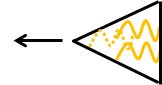
The MiHsC explanation of emdrive is in a similar line but the derivation is more difficult because there’s no open end now. MiHsC says that the zero point field can be made to vary in space by setting up horizons (these can be real Casimir plates or abstract information horizons). In the emdrive then the supercharged zero point field in the copper cone is more energetic at the wide end (see diagram below, note the waveforms shown are cartoons only). There is now a gradient in it from which work can be extracted, just as the Casimir effect gets energy to move from the gradient it creates in the zero point field.

One way to work out the effect of MiHsC on the emdrive is to consider the photons resonating within it. On moving towards the wide end of the cone, the photons are moving to a more energetic zero point field and so gain inertial mass due to MiHsC (yes, light has inertial mass, the Japanese have just tested a light sail: IKAROS). Going the other way the photons lose mass. The almighty cosmic accountant says "Oh dear! Net mass is going towards the right, so I'd better conserve momentum & move the emdrive to the left. Make it so!". In this new way MiHsC predicts the observed emdrive thrust quite well. As shown in the bar chart below which shows the thrust data (the purple bars) from the eight emdrive experiments so far, and the MiHsC prediction in red. For the details, see my paper below.


References

Chakrabarty, A. Konya, A., Wang, F., Selinger, J.V., Sun K., Wie, .H., 2013. Brownian motion of boomerang colloidal particles. Phys. Rev. Lett., 111, 160603.

McCulloch, M.E., 2015. Testing quantised inertia on the emdrive. EPL, 111, 60005. PDF

Tuesday, 16 February 2016

Comment on LIGO Gravitational Waves

The LIGO project is a bit like a rich man's Michelson-Morley experiment. To simplify the explanation, they fire a laser beam into the centre of the contraption, which splits the beam sending it down two perpendicular 4km arms to mirrors. The beams bounce back to the centre and are redirected to a detector which checks to see if the peaks and troughs of the light waves are still aligned. Last week LIGO announced that the emerging waves were very very slightly not aligned, implying that the difference in the two arms' lengths had varied by 0.0001 times the width of a proton in a way that looked like the gravitational waves predicted by general relativity (GR) due to two black holes merging.

I've been asked whether this is relevant to MiHsC. The answer is that if it really is from a high acceleration distant process then 'no' since MiHsC usually only makes a difference to GR at very low accelerations or large scales (of the order of 10^-10 m/s^2, or tens of kpc), and at higher accelerations MiHsC reduces to general relativity since in that regime the MiHsC inertial mass tends towards the gravitational mass (if it's due to local changes in light speed, then it might be relevant).

The search for new data is a fantastic thing, so LIGO should be congratulated for that. The thing that bothers me about the gravitational wave paper is whether the twin black-hole merger scenario they pigeon-holed it with can be falsified or tested independently? I suspect it can't, and so this is like a lot of post-modern physics: unfalsifiable.

Imagine someone invents a Theory of Exploding Mushrooms (TEM). They have brilliant success predicting small mushroom blasts at home. Then people using ear-horns hear odd bangs from the distant forest. "It's my theory of exploding mushrooms!", the scientist says in glee and enthusiastically calculates the size of the unseen mushrooms that may be exploding. No one can go to check this prediction, and some people grumble that with the greatest respect, the TEM actually only managed to predict 4% of the exploding mushrooms that have subsequently been seen on the edge of the forest, and also the theory is incompatible with the famous Theory of Quantum Fungi...

In the gravity wave paper (see below) they say that the merger and the 'ring down' of the black hole are consistent with each other given GR, but this is an example of fitting using a computer model. They have found the black hole model that fits the data, but no one can go and look. It is not falsifiable. So it is not science.

Carl Sagan once said: extraordinary claims need extraordinary evidence. This applies to this case. They are invoking extraordinary directly-invisible entities and this needs independent backup. I feel that the usual standards are not being applied to the pathway that the majority of physicists occupy.

References

Abbott, B.P. et al., 2016. Observation of gravitational waves from a binary black hole merger. PRL, 116, 061102. http://arxiv.org/ftp/arxiv/papers/1602/1602.03837.pdf

Friday, 12 February 2016

Presentation on MiHsC

I haven't posted here for a few weeks because I've been inundated preparing a new Space Exploration course for Plymouth University First Year Students. Today, after going through relativity and the philosophy of it, I finally gave the students (a good keen bunch) a presentation about my own work.

I started by pointing out the big problem, which has been brushed under the carpet, which is that galaxies spin too fast in their outer parts and the centrifugal forces should pull them apart. I mentioned the deeply unpleasant hypothesis of dark matter that is added to their edges to make general relativity fit the visible mass and velocity data. I added the interesting commonality which is that the problems always start at galactic radii when the stars go below an acceleration of around 10^-10 m/s^2 and the observation that globular clusters (star congregations within galaxies) show the same odd behaviour as large galaxies but dark matter can't be used to fix globulars because it has to stay spread out at the galactic edge to fix the galaxies.

I then showed how an object accelerating in one direction develops a Rindler horizon in the opposite direction and this damps the Unruh radiation in such a way that more radiation hits them from in front then from the back and how this predicts inertial mass for the first time (McCulloch, 2013). In the past it's always been assumed that "things keep going": shallow language only.

I then showed that this new model (MiHsC) predicts that inertia dissipates in a new way at very low accelerations in just the way needed to explain galaxy rotation without dark matter (McCulloch, 2012). The predicted effects also appear at that critical acceleration of 10^-10 m/s^2. MiHsC also predicts the recently observed cosmic acceleration without dark energy (McCulloch, 2007, 2010) and fits the low-l CMB anomaly and the pioneer and Tajmar anomalies, the emdrive & others. I then briefly went through Maxwell's Demon, Szilard's Engine and Landauer's principle and showed how I'm now attempting to re-derive MiHsC using information loss on horizons and how I can get similar formula, but with an as-yet too simple model.

Just when the students were recovering from this I showed them a swastika (no politics here) and told them that if this was put nanoscale into the zero point field then it would act like an array of Rindler horizons, and create new circular motion to generate energy. I showed them Luke's speeder on Tatooine and said all it needs is an Unruh-damping horizon above it to float, and a fuel-less interstellar vessel, with a horizon in front which should move getting its energy from the inhomogeneity in the zero point field caused by the horizon.

Some of the students said they were 'Blown away'. So it'll be a hard lecture to follow: my next lecture is on exploration by maths (what I do most of the time), then 'alien possibilities'. Anything short of presenting a stargate is going to be a dissapointment, but dissapointment too is an education: these things are not flash in the pan. It's a long hike, or should I say trek? It's now over 10 years since I started.

References

McCulloch, M.E., 2013. Inertia from an asymmetric Casimir effect. EPL, 101, 59001. http://arxiv.org/abs/1302.2775

McCulloch, M.E., 2012. Testing quantised inertia on galactic scales. A&SS. Vol. 342, No. 2, 575-578. http://arxiv.org/abs/1207.7007

McCulloch, M.E., 2010. Minimum accelerations from quantised inertia. EPL, 90, 29001. http://arxiv.org/abs/1004.3303

McCulloch, M.E., 2007. Modelling the Pioneer anomaly as modified inertia. MNRAS, 376(1), 338-34. http://arxiv.org/abs/astro-ph/0612599

Saturday, 16 January 2016

Ulysses also showed a Pioneer anomaly

In 2011 it all went quiet on the Pioneer anomaly, because some studies found they could model it assuming complex thermal emission, and so the community was quickly brought into line and ever since at conferences I've been told off whenever I mention it, which makes me feel even more that it is my duty to mention it.

First of all, and this is something you never hear about, the Pioneer anomaly was also shown by another spacecraft: the Ulysses spacecraft which was launched, via a gravity assist at Jupiter, into an orbit around the Sun out of the plane of the ecliptic. The Ulysses orbit could only be explained, said Anderson et al. (1998) (see ref below, page 2) if they included an unexpected acceleration of 12+/-3x10^-10 m/s^2 towards the Sun, in agreement with the Pioneer anomaly of 8.74+/-1.33x10^-10 m/s^2. The Ulysses spacecraft had a different orientation to the Pioneer craft so it's very unlikely thermal emission would apply in the same way.

This supports my opinion that the Pioneer anomaly has been brushed under the carpet by a complex thermal model (that has 1000s of finite elements and two adjustable parameters) rather like the galaxy rotation anomaly has been brushed under the carpet using vague and complex dark matter models. Uncomfortable contrary data like the Ulysses data in the case of Pioneer, or dwarf galaxies in the case of dark matter, have been hidden away in a dark closet like a grumbling relative with a higher standard of cleanliness, but they are still there, muffled but more determined than ever to expose sloppy practices.

Going further, the Pioneer anomaly is not only supported as an anomaly, to the standard model, by the Ulysses data, but also by the galaxy rotation anomaly, the anomalous cosmic acceleration, the flyby anomalies, dwarf galaxies, the Tajmar effect, the emdrive and many more, all of which are easily solved by the same acceleration shown by the Pioneer craft, an acceleration that appears naturally within the framework of MiHsC (see my papers below for the solutions for the Pioneer, galactic and cosmic acceleration).

The fact that the same number 2(SpeedofLight)^2/(HubbleScale) ~ 8x10^-10 m/s^2 keeps cropping up all over the place, should really get massive attention. This is direct evidence for MiHsC, because only MiHsC predicts that crucial number (even in MoND for example this odd number has to be put in by hand).

 References

Anderson et al., 1998. Indication from Pioneer 10/11, Galileo and Ulysses data of an Apparent Anomalous, Weak, Long-range Acceleration. Phys.Rev.Lett. 81 (1998) 2858-2861. http://arxiv.org/abs/gr-qc/9808081
McCulloch, M.E., 2007. Modelling the Pioneer anomaly as modified inertia. MNRAS, 376, 338-342. http://arxiv.org/abs/astro-ph/0612599   
McCulloch, M.E., 2010. Minimum accelerations from quantised inertia. EPL,, 90, 29001.
McCulloch, M.E., 2012. Testing quantised inertia on galactic scales. A&SS, 342, 2, 575-578. http://arxiv.org/abs/1207.7007

Saturday, 9 January 2016

Interstellar MiHsCjet

Yesterday, I gave a talk titled "Human Space Exploration: from Tsiolkovski to Time Peake" to the Plymouth Astronomical Society, and talked at the end about interstellar travel. I explained how relativity means you can get to any star in the galaxy in the lifetime of those travelling (but not those left on Earth) if you can accelerate quickly (to avoid the effects of general relativity on time), get close to the speed of light (c) and cruise, then special relativistic time dilation slows everything down on the ship. It works a bit like suspended animation but without the need for cryogenics. For example, if you accelerate for an Earth-year at 9.8 m/s^2, then cruise for 23 Earth-years at 0.9c, then decelerate equally quickly, you can get to Gliese 667 (which is Earth-like and 23.6 light years away) in about 25 years as measured from Earth and only 12 years as experienced on the ship. I then made the crucial point that travel agencies are not yet offering package tours to Gliese because accelerating to 0.9 times the speed of light takes over 300 times the energy generated by our civilisation in a year.

Not to worry: there are a few bold suggestions for how to get to 0.9c, including antimatter rockets that are propelled by radiation from, for example, electron-positron annihilations, interstellar ramjets that focus and fuse hydrogen collected in deep space, so they avoid carrying heavy fuel and so can accelerate more easily, and Alcubierre drives that bend space and unfortunately need negative matter. I also mentioned my own suggestion (McCulloch, 2013) which is a MiHsC-drive which, like the ramjet, avoids carrying fuel. It is shown in this schematic:


The circle in the centre is the spacecraft core, and it holds in front of it a metamaterial shield (the dashed curve on the left) that can damp Unruh waves. If the spacecraft is accelerated it will see Unruh radiation as shown by the red & orange wavy lines all around it. If the metamaterial shield is set up the right way it will disallow waves in front of the spacecraft (left) so there will be fewer there (the orange wave has less amplitude) and the craft will feel more Unruh radiation pressure from the back then from the front and this will accelerate it forward (the black arrow), and it will do it without the need to carry fuel. The fuel, like the ramjet, is available en route: in this case from the quantum vacuum, made inhomogenous by a manmade horizon. Note: I think the emdrive is inhomogenising the vacuum in a similar way (see McCulloch, 2015).

References

McCulloch, M.E., 2013. Inertia from an asymmetric Casimir effect. EPL, 101, 59001. http://arxiv.org/abs/1302.2775

McCulloch, M.E., 2015. Testing quantised inertia on the emdrive. EPL, 111, 60005.  http://iopscience.iop.org/article/10.1209/0295-5075/111/60005